Tutorial: Surface Geometry - The 2-Sphere
- Goal: Demonstrate intrinsic curvature on a 2-sphere embedded in $R^3$.
- Key Symbols: Manifold
:S2, Chart:Sph. - Curvature: Ricci Scalar $R = 2/R^2$.
- Prerequisites:
XAct.jl,Plots.jl,LinearAlgebra.
This tutorial explores intrinsic curvature using the 2-sphere ($S^2$) embedded in 3D Euclidean space. We will calculate the induced metric on the sphere and compute its Riemann curvature tensor and Ricci scalar to show that the surface is curved even though the ambient space is flat.
1. Setup
If running on Google Colab or a fresh environment, install the required packages first.
# Uncomment the lines below if running on Google Colab:
# using Pkg
# Pkg.add(url="https://github.com/sashakile/XAct.jl.git")
# Pkg.add("Plots")
2. Setup
Load the required modules.
using XAct
using Plots
using LinearAlgebraAlways call reset_state!() before defining a manifold to avoid "Symbol already exists" errors when re-running cells.
2. Define the Manifold and Chart
We define a 2D manifold $S^2$ with abstract indices.
reset_state!()
M = def_manifold!(:S2, 2, [:a, :b, :c, :d, :th, :ph])
@indices S2 a b c d th ph

# Coordinate chart (theta, phi)
def_chart!(:Sph, :S2, [1, 2], [:th, :ph])
ChartObj(:Sph, :S2, [1, 2], [:th, :ph])3. Induced Metric on the 2-Sphere
For a sphere of radius $R$ embedded in $R^3$, the induced metric in spherical coordinates is: $ds^2 = R^2 d\theta^2 + R^2 \sin^2\theta d\phi^2$
def_metric!(1, "g[-a,-b]", :CD)

function sphere_metric(R, θ)
    [R^2 0;
     0 R^2*sin(θ)^2]
end

R_val = 1.0
θ_val = pi/4
g_comp = sphere_metric(R_val, θ_val)

set_components!(:g, g_comp, [:Sph, :Sph])

println("Induced metric components at θ = π/4 (R=1):")
g_comp
2×2 Matrix{Float64}:
1.0 0.0
0.0 0.54. Visualization: The 2-Sphere
Let's visualize the surface we are analyzing.
function plot_sphere(R)
    θs = range(0, π, length=30)
    φs = range(0, 2π, length=60)

    xs = [R * sin(θ) * cos(φ) for θ in θs, φ in φs]
    ys = [R * sin(θ) * sin(φ) for θ in θs, φ in φs]
    zs = [R * cos(θ) for θ in θs, φ in φs]

    surface(xs, ys, zs, alpha=0.8, color=:viridis,
            title="The 2-Sphere (R=$R)", aspect_ratio=:equal)
end

plot_sphere(R_val)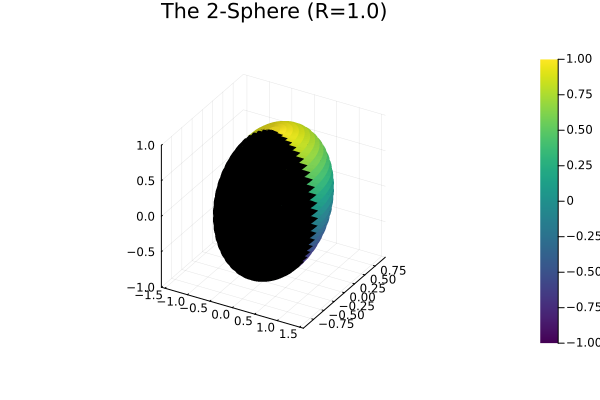
5. Intrinsic Curvature
The Riemann tensor $R^a{}_{bcd}$ measures the intrinsic curvature of the manifold. For a sphere of radius $R$, the Ricci scalar $R = g^{ab} R_{ab}$ should be a constant: $R = 2/R^2$.
# Riemann, Ricci, and RicciScalar are auto-created by def_metric!
Riem = tensor(:RiemannCD)
Ric  = tensor(:RicciCD)
RS   = tensor(:RicciScalarCD)

# For a sphere of R=1, the Ricci Scalar should be exactly 2.
# We use Contract to evaluate the scalar expression.
val = Contract(RS[])
println("Ricci Scalar (expected 2.0): ", val)
Ricci Scalar (expected 2.0): RicciScalarCD[]6. Symbolic Algebra: Leveraging the Engine
The real power of XAct.jl lies in its ability to manipulate tensor expressions abstractly. Instead of just calculating numbers, we can verify geometric identities that must hold for any metric.
For example, the Einstein tensor $G_{ab}$ is defined as: $G_{ab} = R_{ab} - \frac{1}{2} g_{ab} R$
Let's use the engine to verify that the trace of the Einstein tensor in 2D is exactly $-R$ (which implies $R_{aa} = 0$ in 2D, a unique property of surface geometry).
G = tensor(:EinsteinCD)
g = tensor(:g)

# Compute the trace: g^{ab} G_{ab}
# In 2D, this should simplify based on the definition.
trace_G = Contract(g[a, b] * G[-a, -b])

println("Trace of Einstein tensor (g^{ab} G_{ab}):")
trace_G
0
By leveraging ToCanonical and Contract, we can prove complex identities without ever choosing a coordinate system.
7. Summary
Key Takeaways: Intrinsic Geometry
This tutorial demonstrated:
- Defining a manifold for a curved surface.
- Calculating the induced metric from an embedding.
- Visualizing the surface.
- Verifying intrinsic curvature by computing the Ricci Scalar ($R = 2$).
Next Steps
- Schwarzschild: Move to 4D Spacetime in the Schwarzschild Geodesics tutorial.
- 3D Geometry: Review 3D coordinate systems in Curvilinear Coordinates.
- Core Guide: See the Typed Expressions (TExpr) guide.