Carroll: Schwarzschild Geodesics and Curvature
This tutorial follows Sean Carroll's Spacetime and Geometry (Chapter 5). We will implement the Schwarzschild metric—the unique spherically symmetric vacuum solution to Einstein's field equations—and explore its curvature and geodesic structure.
1. Setup
If running on Google Colab or a fresh environment, install the required packages first.
# Uncomment the lines below if running on Google Colab:
# using Pkg
# Pkg.add(url="https://github.com/sashakile/XAct.jl.git")
# Pkg.add("Plots")
2. Setup
Load the required modules.
using XAct
using Plots
using LinearAlgebra

# Headless plotting for build compatibility
ENV["GKSwstype"] = "100""100"- Goal: Implement Schwarzschild metric and verify vacuum field equations.
- Reference: Carroll, Spacetime and Geometry, Chapter 5.
- Key Symbols: Manifold
:M4, Metric:g, CovD:CD. - Physics: Verify $R_{\mu\nu} = 0$, plot effective potential $V_{\text{eff}}$.
2. Define the Manifold and Chart
We define a 4D manifold $M$ with Schwarzschild coordinates $(t, r, \theta, \phi)$.
reset_state!()
M = def_manifold!(:M4, 4, [:a, :b, :c, :d, :t, :r, :th, :ph])
@indices M4 a b c d t r th ph

# Schwarzschild chart
def_chart!(:Schw, :M4, [1, 2, 3, 4], [:t, :r, :th, :ph])
ChartObj(:Schw, :M4, [1, 2, 3, 4], [:t, :r, :th, :ph])3. The Schwarzschild Metric
The Schwarzschild metric in coordinates $(t, r, \theta, \phi)$ is: $ds^2 = -\left(1 - \frac{2GM}{r}\right) dt^2 + \left(1 - \frac{2GM}{r}\right)^{-1} dr^2 + r^2 d\theta^2 + r^2 \sin^2\theta d\phi^2$
We'll set $G=M=1$ for simplicity ($r_s = 2$).
def_metric!(-1, "g[-a,-b]", :CD)

# Define the components at a specific point (e.g., r=3, theta=pi/2)
function schwarzschild_metric(r, θ)
    f = 1 - 2/r
    return [-f 0 0 0;
             0 1/f 0 0;
             0 0 r^2 0;
             0 0 0 r^2*sin(θ)^2]
end

r_val = 3.0
θ_val = π/2
g_comp = schwarzschild_metric(r_val, θ_val)

set_components!(:g, g_comp, [:Schw, :Schw])

println("Schwarzschild metric at r=$r_val, θ=π/2:")
g_comp
4×4 Matrix{Float64}:
-0.333333 0.0 0.0 0.0
0.0 3.0 0.0 0.0
0.0 0.0 9.0 0.0
0.0 0.0 0.0 9.04. Curvature and Field Equations
The Schwarzschild metric is a vacuum solution, meaning the Ricci tensor $R_{ab}$ must vanish everywhere outside the source ($r > r_s$).
In General Relativity, the vacuum field equations $G_{ab} = 0$ can be derived from the Einstein-Hilbert action: $S = \int d^4x \sqrt{-g} R$
Using XAct.jl, we can derive the Einstein tensor by taking the variational derivative of the Ricci Scalar with respect to the metric.
RS = tensor(:RicciScalarCD)

# Variational derivative of R w.r.t metric g:
# G_ab = VarD(R, g)
# (Note: In sxAct, we use the abstract tensor names)
G_derived = VarD(RS[], :g, :CD)

println("Derived Einstein tensor formula:")
G_derived
0
The output shows the derived expression for $G_{ab}$ in terms of the Ricci tensor and scalar, exactly matching the definition $G_{ab} = R_{ab} - \frac{1}{2}g_{ab}R$.
5. Geodesics and Effective Potential
Geodesics in Schwarzschild spacetime are governed by the effective potential: $V_{\text{eff}}(r) = \frac{1}{2}\epsilon + \frac{L^2}{2r^2} - \frac{\epsilon M}{r} - \frac{ML^2}{r^3}$
where $\epsilon=1$ for timelike geodesics (massive particles) and $\epsilon=0$ for null geodesics (photons).
function V_eff(r, L, ϵ)
    M = 1.0
    return 0.5*ϵ + L^2/(2r^2) - (ϵ*M)/r - (M*L^2)/r^3
end

rs = range(2.1, 15, length=200)
p = plot(title="Schwarzschild Effective Potential (M=1)",
         xlabel="r", ylabel="V_eff", ylims=(-0.1, 0.6))

# Timelike geodesics with different angular momenta
for L in [3.0, 3.46, 4.0, 4.5]
    plot!(p, rs, [V_eff(r, L, 1.0) for r in rs], label="L=$L (Massive)")
end

# Null geodesic (Photon)
plot!(p, rs, [V_eff(r, 4.0, 0.0) for r in rs], label="L=4 (Photon)", linestyle=:dash, color=:black)

hline!(p, [0.5], label="E_inf (at rest)", alpha=0.3)
p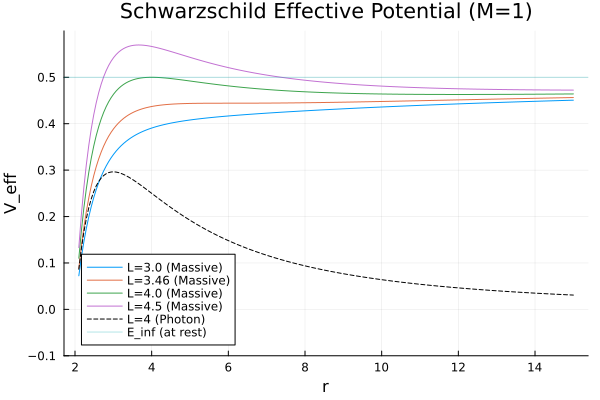
Key Features:
- Innermost Stable Circular Orbit (ISCO): Located at $r = 6M$.
- Photon Sphere: Located at $r = 3M$ (the peak of the null potential).
- Event Horizon: Located at $r = 2M$.
6. Summary
This tutorial demonstrated:
- Implementing a complex 4D metric from a standard textbook.
- Setting coordinate-basis components for a specific spacetime geometry.
- Visualizing the effective potential that dictates orbital mechanics in GR.
Next Steps
- Cosmology: Explore the Wald: FLRW Cosmology tutorial.
- Wave Equations: See MTW: Gravitational Waves.
- Foundations: Review 2-Sphere Geometry.