Tutorial: 3D Geometry - Curvilinear Coordinates
- Goal: Compare 3D coordinate systems and demonstrate tensor vector calculus.
- Key Symbols: Manifold
:M, Charts:Cart,:Cyl,:Sph. - Calculus: Gradient ($\nabla_a \Phi$), Divergence ($\nabla_a V^a$).
- Prerequisites:
XAct.jl,Plots.jl,LinearAlgebra.
This tutorial extends our foundational geometry exploration to 3D Euclidean space ($R^3$). We will compare Cartesian, Cylindrical, and Spherical coordinate systems and demonstrate how standard vector calculus operators (Gradient, Divergence) are represented in the language of tensors.
1. Setup
If running on Google Colab or a fresh environment, install the required packages first.
# Uncomment the lines below if running on Google Colab:
# using Pkg
# Pkg.add(url="https://github.com/sashakile/XAct.jl.git")
# Pkg.add("Plots")
2. Setup
using XAct
using Plots
using LinearAlgebraXAct.jl maintains a global registry. If you re-run definition cells without calling reset_state!(), you will encounter "Symbol already exists" errors.
2. Define the Manifold and Charts
We define a 3D manifold $R^3$ with abstract indices.
reset_state!()
M = def_manifold!(:M, 3, [:a, :b, :c, :d, :x, :y, :z, :r, :th, :ph])
@indices M a b c d x y z r th ph
Define three coordinate charts:
- Cartesian ($x, y, z$)
- Cylindrical ($\rho, \phi, z$) — using symbols $r, \phi, z$
- Spherical ($r, \theta, \phi$) — using symbols $r, \theta, \phi$
def_chart!(:Cart, :M, [1, 2, 3], [:x, :y, :z])
def_chart!(:Cyl,  :M, [1, 2, 3], [:r, :ph, :z])
def_chart!(:Sph,  :M, [1, 2, 3], [:r, :th, :ph])
ChartObj(:Sph, :M, [1, 2, 3], [:r, :th, :ph])3. The Euclidean Metric
In Cartesian coordinates, the Euclidean metric is simply $\delta_{ij} = \text{diag}(1, 1, 1)$.
def_metric!(1, "g[-a,-b]", :CD)
set_components!(:g, [1 0 0; 0 1 0; 0 0 1], [:Cart, :Cart])
CTensorObj{Int64, 2}(:g, [1 0 0; 0 1 0; 0 0 1], [:Cart, :Cart], 0)4. Visualization: Spherical Coordinate Surfaces
In 3D, each coordinate defines a family of surfaces:
\[r = \text{const}\]
(Spheres)\[\theta = \text{const}\]
(Cones)\[\phi = \text{const}\]
(Half-planes)
Let's visualize a sphere of constant $r$.
function plot_spherical_surface(r_val)
    θs = range(0, π, length=30)
    φs = range(0, 2π, length=60)

    xs = [r_val * sin(θ) * cos(φ) for θ in θs, φ in φs]
    ys = [r_val * sin(θ) * sin(φ) for θ in θs, φ in φs]
    zs = [r_val * cos(θ) for θ in θs, φ in φs]

    surface(xs, ys, zs, alpha=0.6, title="Spherical Coordinate Surface (r=$r_val)",
            xlabel="x", ylabel="y", zlabel="z", aspect_ratio=:equal)
end

plot_spherical_surface(1.5)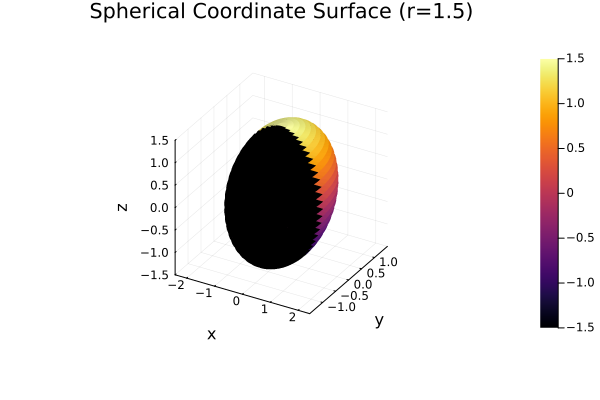
5. Metric in Spherical Coordinates
For a point $(r, \theta, \phi)$, the metric is: $ds^2 = dr^2 + r^2 d\theta^2 + r^2 \sin^2\theta d\phi^2$
function spherical_metric(r_val, th_val, ph_val)
    [1 0 0;
     0 r_val^2 0;
     0 0 r_val^2*sin(th_val)^2]
end

r_val, th_val, ph_val = 1.0, pi/4, pi/2
g_sph = spherical_metric(r_val, th_val, ph_val)

println("Metric in Spherical coordinates at (r=$r_val, θ=$th_val, φ=$ph_val):")
g_sph
3×3 Matrix{Float64}:
1.0 0.0 0.0
0.0 1.0 0.0
0.0 0.0 0.56. Vector Calculus as Tensor Algebra
In abstract index notation, standard operators are elegantly expressed:
- Gradient of a scalar $\Phi$: $\nabla_a \Phi$
- Divergence of a vector $V^a$: $\nabla_a V^a$
- Laplacian of a scalar $\Phi$: $\nabla^a \nabla_a \Phi = g^{ab} \nabla_a \nabla_b \Phi$
# Define a vector and scalar field
def_tensor!(:V, ["a"], :M)
def_tensor!(:Phi, String[], :M)

V = tensor(:V)
Phi = tensor(:Phi)

# Gradient: CD[-a](Phi[])
# Divergence: Contract(CD[-a](V[a]))
# Laplacian: Contract(g[a,b] * CD[-a](CD[-b](Phi[])))TensorHead(:Phi)7. Volume Element
The 3D volume element in spherical coordinates is $dV = \sqrt{|g|} dr d\theta d\phi = r^2 \sin\theta dr d\theta d\phi$.
sqrt_det_g = sqrt(det(g_sph))
textbook_val = r_val^2 * sin(th_val)

println("Metric volume factor: ", sqrt_det_g)
println("Textbook value (r^2 sin θ): ", textbook_val)
Metric volume factor: 0.7071067811865475
Textbook value (r^2 sin θ): 0.70710678118654758. Symbolic Identities: Ricci and Riemann
In 3 Dimensions, the Riemann tensor is entirely determined by the Ricci tensor. While we can't show the full 3D-specific vanishing of the Weyl tensor here without coordinate expansion, we can show how XAct.jl manages the abstract relations between these tensors.
For example, let's verify that the trace of the Ricci tensor is indeed the Ricci Scalar.
Ric = tensor(:RicciCD)
RS  = tensor(:RicciScalarCD)
g   = tensor(:g)

# Verify the definition: g^{ab} R_{ab} - R = 0
identity = Simplify(Contract(g[a, b] * Ric[-a, -b]) - RS[])

println("Identity check (g^{ab} R_{ab} - R):")
identity
R^{\a}^{\b} - R
Using these abstract tools, we can manipulate high-rank tensor equations (like the decomposition of the Riemann tensor into Ricci and Weyl parts) with complete mathematical rigor.
9. Summary
Key Takeaways: 3D Curvilinear Systems
This tutorial showed:
- Defining 3D manifolds and multiple curvilinear charts.
- Representing standard vector calculus operators as tensor contractions.
- Verifying volume elements in non-Cartesian bases.
Next Steps
- Curvature: Explore intrinsic curvature in The 2-Sphere.
- Basics: Review 2D transformations in Polar vs. Cartesian.
- Core Guide: See the Typed Expressions (TExpr) guide.